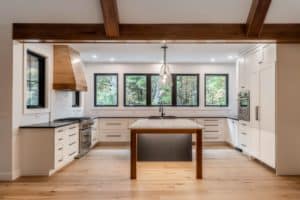
A kitchen on the Maine coast isn’t just a kitchen. It’s a room where morning light reflects off the water and bounces across painted shaker doors. It’s where salt air drifts through an open window while you’re cooking lobster in August. And it’s one of the most demanding environments a cabinet can live in. If you’re building or renovating a coastal home in Maine — whether you’re in Falmouth, Freeport, Camden, or Bar Harbor — the materials you choose for your cabinetry need to do more than look beautiful. They need to last.
At Maine Cabinet Company, we’ve spent years helping coastal homeowners navigate exactly this decision. Here’s what you need to know about choosing the right materials, finishes, and hardware for a kitchen that performs as well as it looks.
Why Coastal Maine Kitchens Demand Different Cabinet Choices
The Maine coastline is extraordinary — and merciless to materials that aren’t built for it. Homeowners in Portland, Yarmouth, Freeport, Brunswick, Boothbay, Rockport, and beyond share a common set of environmental pressures that inland kitchens simply don’t face.
Salt air is the biggest factor. Sodium chloride particles suspended in ocean air accelerate oxidation on metal surfaces, degrade standard lacquer finishes over time, and seep into any gap or pore in a cabinet’s construction. The closer you are to the water, the more aggressive this effect becomes. A summer cottage in Boothbay Harbor will experience far more salt exposure than a home ten miles inland.
Humidity is the second challenge. Coastal Maine homes, particularly those on peninsulas and islands near Rockport, Camden, and Bar Harbor, experience persistently elevated relative humidity throughout the warmer months. Wood expands and contracts. Doors that fit perfectly in October may bind or gap in July. Cabinets built without attention to this reality simply don’t hold up.
Finally, there’s light. Coastal kitchens often feature large windows and open sightlines designed to capture the water. That’s beautiful — and it also means your cabinet finishes are under near-constant UV exposure. Colors fade. Gloss levels shift. The wrong finish will look tired within a few seasons.
The good news: when you build for the coast from the start, the result is a kitchen that’s not just durable but genuinely exceptional. Coastal kitchen cabinets in Maine don’t have to compromise on aesthetics — they just require more informed choices.
Best Cabinet Core Materials for Coastal Homes
The cabinet box — the structural core hidden behind the doors and drawer fronts — is where long-term durability is won or lost. The face of your cabinet is what you see; the core is what survives.
Plywood Core (Recommended)
Plywood is the gold standard for coastal applications. Unlike particleboard or MDF, plywood is manufactured from cross-laminated wood veneers bonded with moisture-resistant adhesive. This cross-grain construction gives plywood exceptional dimensional stability — it resists swelling and warping far better than single-grain composites when humidity fluctuates. Look for cabinet-grade plywood bonded with waterproof phenolic or exterior-grade glue. The USDA Forest Products Laboratory, which has studied wood performance in extreme environments for over a century, confirms that properly bonded plywood panels significantly outperform particleboard in high-humidity conditions — a critical advantage for Maine coastal homes.
Solid Wood (Premium, With Caveats)
Solid wood doors and face frames are a hallmark of heirloom-quality cabinetry — and certain species are particularly well-suited to coastal environments. White oak has a tight, dense grain that resists moisture penetration and is one of the most dimensionally stable domestic hardwoods available. Teak, long prized in marine architecture for its natural oils and exceptional resistance to rot and humidity, is an outstanding choice for coastal kitchens where budget allows.
The key with solid wood in coastal settings is proper acclimation. Solid wood panels must be allowed to reach equilibrium with the local environment before installation. A cabinet built and shipped from a climate-controlled facility, then installed in a humid coastal home without acclimation time, will move. Work with a cabinet maker who understands this and builds it into their process.
What to Avoid: Particleboard Core
Particleboard — compressed wood chips and sawdust bonded with adhesive — is the most common core material in budget and mid-range cabinetry. In a dry inland kitchen, it performs adequately. In a coastal home, it’s a liability. Particleboard swells when it absorbs moisture, and once it begins to break down, the cabinet box loses structural integrity. Drawer bottoms sag. Doors warp. Hinges pull out of softened substrate. For coastal kitchen cabinets in Maine, particleboard core is a material we simply don’t recommend.
Finish Options That Hold Up to Salt Air
Even the best cabinet core needs a finish engineered to handle coastal conditions. Standard finishes applied in landlocked factories may not stand up to years of salt air and UV exposure by the water.
Catalyzed Lacquer
Catalyzed lacquer — sometimes called conversion varnish — is a two-component finish that cross-links chemically as it cures, creating a film that is significantly harder and more resistant to moisture than conventional nitrocellulose lacquer. For painted or clear-finished cabinets in coastal settings, catalyzed lacquer is one of the best options available. It’s what professional cabinet finishers specify when durability is non-negotiable.
Polyurethane-Based Painted Finishes
If you’re drawn to painted cabinets — and many of the most beautiful coastal kitchens in Maine feature painted shaker doors — insist on a polyurethane-based paint system rather than standard water-based latex. Polyurethane paints cure to a harder, more flexible film that holds up better under repeated cleaning and resists the micro-abrasion of salt-laden air over time.
UV-Stable Finishes
Large coastal windows are a blessing and a challenge. Finishes without UV stabilizers will yellow, fade, or chalk under sustained sun exposure. Ask your cabinet maker specifically about UV-stable topcoats if your kitchen faces south or east, or if you have water-facing windows that let in hours of direct light each day.
Color Considerations
Light colors — whites, creams, soft greiges — are perennially popular in coastal kitchens and tend to show dust and fingerprints more readily, but they maximize the bright, airy quality of a coastal interior. Darker colors — navy, deep forest green, charcoal — have become increasingly popular for lower cabinets and islands in coastal Maine homes, and they can be stunning against natural light. With dark painted finishes, UV fading is more visually apparent; a UV-stable topcoat is especially important.
Hardware That Won’t Corrode by the Water
Cabinet hardware is where coastal homeowners most visibly discover the cost of cutting corners. Corroded pulls, tarnished hinges, and rusted soft-close mechanisms are not just unsightly — they’re a persistent maintenance headache. The National Kitchen and Bath Association emphasizes specifying materials appropriate to the installation environment, and in coastal applications that means taking hardware selection seriously from the start.
Stainless Steel (304 or 316 Marine Grade)
For exposed hardware — pulls, knobs, and bar handles — stainless steel is the most corrosion-resistant option in the standard hardware market. 316 marine-grade stainless steel, which contains molybdenum for superior salt resistance, is the specification used in boat building and marine architecture. If your home is directly on the water, 316 is worth the modest premium. For homes a few blocks from the coast, 304 stainless performs very well. Marine hardware suppliers such as West Marine provide a useful reference for understanding the difference between 304 and 316 alloys in salt environments.
Solid Brass
Unlacquered or living-finish solid brass is a beautiful choice for coastal kitchens. Unlike brass-plated zinc (more on that below), solid brass develops a natural patina over time that many homeowners love — and critically, it does not pit or corrode the way plated metals do. Brass is inherently resistant to salt air and has been used in marine applications for centuries for exactly this reason.
What to Avoid: Chrome-Plated Zinc
Most budget-grade cabinet hardware is zinc die-cast with a chrome or nickel plating. In coastal environments, this plating breaks down, and once it does, the zinc substrate corrodes rapidly. The pitting and white powder that result are essentially irreversible. Replacing cheap hardware every few years is a false economy — specify the right material once.
Soft-Close Mechanisms
Soft-close hinges and drawer slides are exposed to interior cabinet air, which in coastal homes is often more humid than in a controlled indoor environment. Choose mechanisms rated for humid environments, and look for slides with stainless steel or coated components. European hinge manufacturers such as Blum and Grass produce soft-close mechanisms specifically designed for demanding conditions.
Coastal Kitchen Design Styles That Work in Maine
The good news about building for durability in coastal Maine is that the most performance-oriented material choices also happen to align beautifully with the design aesthetics that make coastal Maine kitchens so compelling.
Classic New England
White or soft-white painted shaker cabinets with brushed nickel or polished chrome hardware are the quintessential New England coastal kitchen. Clean lines, timeless proportions, and a palette that reflects natural light — this look works as well in a Victorian summer cottage in Camden as it does in a modern farmhouse in Freeport. Pair with marble or Calacatta quartz countertops for a kitchen that feels genuinely of its place.
Modern Coastal
Natural white oak with integrated, handle-free doors has become one of the most sought-after looks for contemporary coastal homes in Maine. The warm, organic grain of white oak reads beautifully against ocean views, and its natural moisture resistance makes it a particularly good fit for the coast. Pair with soapstone or honed quartz countertops and minimal stainless hardware for a kitchen that is quietly sophisticated.
Cottage and Farmhouse
Beadboard cabinet door profiles, painted in soft white or historic blues and greens, feel at home in the cottage-style homes that dot the Maine shoreline from Kennebunk to Bar Harbor. Open shelving with solid wood brackets — white oak or painted pine — adds warmth and character. This style rewards the mix of painted lower cabinets with open upper shelving, keeping the kitchen feeling light and connected to the outdoors.
Questions to Ask Your Cabinet Maker
Not every cabinet company builds for coastal conditions. Before you commit to a cabinetry partner, ask these questions directly:
- What core material do you use? The answer should be plywood — ideally with a specific callout of the adhesive or glue specification.
- What finish do you apply, and what’s the cure time? A catalyzed lacquer or conversion varnish requires proper cure time before installation. Rushing this step compromises the finish’s performance.
- Can I see examples from coastal Maine projects? A cabinet maker with real experience building for the Maine coast will have a portfolio of projects in Falmouth, Freeport, Brunswick, Camden, and similar towns. Ask to see them.
- How do you handle acclimation for solid wood components? This question separates cabinet makers who understand the Maine environment from those who don’t.
Our team at Maine Cabinet Company has designed kitchens for homes along the Maine coast from Falmouth to Freeport and beyond. Book a complimentary design consultation to discuss your project — we’ll walk you through material options, finish samples, and hardware selections specific to your home’s location and exposure.
Frequently Asked Questions
Do I need special cabinets for a coastal home?
Yes — not in the sense that coastal cabinets are an entirely different product, but in the sense that material and finish choices matter more in coastal environments. The core, finish, and hardware specifications that are adequate for an inland kitchen may fail prematurely in a home near the water. Choosing plywood cores, catalyzed finishes, and corrosion-resistant hardware at the outset costs modestly more but prevents far more expensive repairs or replacements down the line.
What’s the best wood for coastal kitchen cabinets?
For cabinet doors and face frames, white oak is one of the best choices for coastal Maine applications — its tight grain, natural tannins, and dimensional stability make it well-suited to humidity fluctuations. Teak is exceptionally durable but comes at a premium. For cabinet boxes, furniture-grade plywood with moisture-resistant adhesive is the recommended substrate regardless of the face wood species.
How do I protect cabinet hardware near the ocean?
Specify the right material from the beginning rather than relying on treatments or maintenance. Solid brass, 304 stainless steel, or 316 marine-grade stainless are the three hardware materials best suited to coastal salt air. Avoid chrome-plated zinc entirely in high-exposure locations. If you’re in a particularly exposed position — a home directly on the water in Boothbay or on a Bar Harbor peninsula — 316 marine-grade stainless is the specification to request.