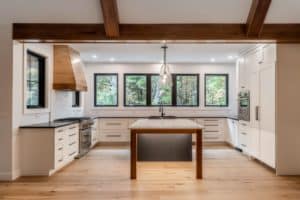
Kitchen cabinet woodworking comes down to three things: what wood the cabinet is built from, how the pieces are joined, and whether the box and doors were made to fit your kitchen or pulled off a standard size chart. Those three choices are what separate a cabinet that holds up for decades from one that starts sagging at the hinges in a few years — and they are almost entirely invisible once the doors are closed and the paint or stain is on. This guide walks through the wood species, the joinery methods, and the construction styles behind a kitchen cabinet, so you know what you are actually looking at the next time you open one.
What Kitchen Cabinet Woodworking Actually Involves
A kitchen cabinet is really three separate assemblies: the box (or “carcass”), the face frame or door system, and the drawers. Each can be built from different materials and joined in different ways, and the combination determines both the price and the longevity of the finished piece. Solid wood is typically reserved for face frames, doors, and drawer fronts, where it is visible and where its strength under repeated opening and closing matters most. Cabinet boxes are more often built from plywood — strong, stable, and resistant to the humidity swings of a working kitchen — with particleboard or MDF used in lower-cost lines where budget outweighs long-term durability.
Wood Species Used in Kitchen Cabinet Woodworking
Hardwoods dominate cabinet woodworking because they hold screws and joinery better than softwoods and take stain and paint more evenly. The species you will see most often:
- Maple — tight, even grain; takes paint exceptionally well, which is why it is the default choice for painted shaker cabinets.
- Oak — pronounced open grain and strong visible figure; a traditional choice that reads as rustic or classic depending on the finish.
- Cherry — fine grain that darkens naturally with light exposure over the years, prized for a warm, furniture-grade look.
- Hickory — the hardest of the common cabinet woods, with dramatic color variation and grain movement.
- Birch — a lighter-grain, budget-friendlier hardwood often used as a maple substitute.
The species you choose affects more than looks: harder woods resist dents and dings at the door edges and hinge points, and tighter grain takes a painted finish without the grain “telegraphing” through the topcoat.
Joinery: The Difference Between a Cabinet That Lasts and One That Doesn’t
Joinery is where cabinet quality is won or lost, and it is almost always hidden from view once the cabinet is installed.
- Dovetail joints — interlocking, angled joints used at drawer corners. They mechanically lock the front, sides, and back together, which is why a dovetailed drawer box resists racking and separation far longer than a stapled or nailed one.
- Mortise-and-tenon joints — a tenon (tongue) on one piece fits into a mortise (slot) on another, most often used to join the vertical stiles and horizontal rails of a face frame. This is the same joint furniture makers have relied on for centuries because it resists the twisting force a face frame takes over years of doors opening and closing.
- Dowel joints — round wooden pins glue two pieces together; common in mid-range cabinetry as a faster alternative to mortise-and-tenon.
- Pocket-screw joints — screws driven at an angle through a pre-drilled pocket; fast and strong for face-frame assembly, though it depends entirely on the screw and glue holding rather than an interlocking wood shape.
- Dado and rabbet joints — grooves cut into one panel to receive the edge of another, used to seat cabinet backs, bottoms, and fixed shelves squarely into the box sides.
Stapled or nailed butt joints are the fastest and cheapest way to assemble a drawer box, and they are also the first thing to fail — the fasteners work loose from repeated racking, and the joint has no mechanical interlock to fall back on. If you want a quick quality check anywhere you can see raw cabinet material — inside a drawer or at the back of a cabinet — the joinery tells you more than the wood species does.
Face-Frame vs. Frameless Woodworking
Two construction styles cover most of the market, and the joinery differs between them:
- Face-frame construction — a solid-wood frame of stiles and rails is built and attached to the front of the box, and the doors are hung from that frame. This is the traditional American style, and it relies on mortise-and-tenon, dowel, or pocket-screw joints to hold the frame square.
- Frameless (European) construction — the box itself is built to full structural strength, usually from thicker plywood, and the doors mount directly to the box sides with no separate frame. This style depends more heavily on precise panel joinery (dado and cam-lock construction) because there is no frame to add rigidity.
Neither style is inherently “better” — the choice is largely aesthetic and about how much interior storage access you want, since frameless cabinets have a slightly larger opening without a face frame in the way.
What Custom Woodworking Adds That Stock Cabinets Don’t
Stock and semi-custom cabinets are built to standard width and height increments and shipped from a catalog. Custom cabinet woodworking starts from your kitchen’s actual dimensions, which changes what is possible in ways that go beyond appearance:
- Dimensions built to the room, not the nearest stock size — no filler panels needed to make a run of cabinets fit a wall.
- Wood species and joinery chosen for the piece, rather than fixed by a manufacturer’s standard line.
- Storage built around how you actually cook — a deeper drawer where you need one, a narrower cabinet where a stock size would waste the space.
- Finish and hardware decided independently, instead of picking from a limited catalog pairing.
Designing Your Kitchen Cabinet Woodworking Project
Maine Cabinet Company designs bespoke kitchen cabinetry in-showroom, then measures your space in-home before anything is built, and handles installation once the cabinetry is complete. That sequence — design, measure, build, install — is what makes it possible to specify the wood species, joinery, and construction style to the actual room rather than to a catalog size. If you are planning a kitchen renovation and want to understand what the cabinetry itself is built from before you commit to a design, that conversation starts with a design consultation.
Frequently Asked Questions
What wood is best for kitchen cabinets?
There is no single “best” — maple is the standard choice for painted cabinets because of its tight grain, oak and hickory suit a more rustic or high-contrast look, and cherry is chosen for a warm finish that deepens with age. The right species depends on the finish and style you want, not just durability.
Are dovetail joints actually worth paying more for?
In drawer boxes, yes — a dovetailed drawer resists the racking stress of daily opening and closing far longer than a stapled butt-joint drawer, and it is one of the easiest quality signals to check yourself by simply opening a drawer and looking at the corners.
What is the difference between face-frame and frameless cabinets?
Face-frame cabinets have a solid-wood frame across the front of the box that the doors hang from; frameless (European-style) cabinets skip the frame and mount doors directly to a reinforced box. Frameless offers slightly more interior access; face-frame is the more traditional look in most Maine homes.
Does custom cabinet woodworking cost more than stock cabinets?
Custom work is priced to the specific project rather than a catalog list, so the right way to compare is a real quote against your kitchen’s dimensions rather than a stock per-cabinet price. A design consultation is the way to get a number specific to your space.
Talk to Someone About Your Kitchen’s Cabinetry
Whether you are comparing wood species, deciding between face-frame and frameless construction, or just want cabinetry built to your kitchen’s actual dimensions instead of a stock size chart, Maine Cabinet Company’s custom cabinetry services start with an in-showroom design conversation. Visit the showroom at 417 US Route 1, Falmouth, ME, call (207) 956-7727, or see how the same construction principles show up across a full project in our guide to custom kitchen cabinets and our breakdown of cabinet parts and components.