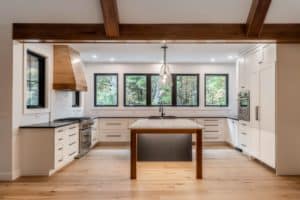
Kitchen cabinets account for nearly 40 percent of a kitchen remodel’s total budget, yet most homeowners spend more time choosing paint colors than selecting the cabinets themselves. This single decision impacts not just aesthetics, but functionality, durability, and resale value for years to come.
Whether you’re upgrading an outdated kitchen or building from scratch, knowing how to pick out kitchen cabinets transforms what feels like an overwhelming choice into a straightforward process. The right cabinets balance your budget, match your home’s style, and deliver the storage and quality you need. This guide walks you through every factor that matters: cabinet types from affordable stock options to fully custom builds, materials ranging from solid wood to plywood and particle board, construction quality markers like dovetail joinery and full-extension drawer guides, and the practical details of sizing, layout, hardware, and finishes.
By the end, you’ll understand exactly what to look for when comparing options side by side, what mistakes to avoid, and how to confidently select cabinets that fit both your kitchen and your wallet. Let’s start with the foundation: understanding the four main types of kitchen cabinets and how they differ in price, customization, and timeframe.
How to Pick Out Kitchen Cabinets
Kitchen cabinets represent one of the most visible and functional elements of any kitchen remodel. They directly impact both your home’s resale value and daily functionality. Choosing the right cabinets requires balancing three key factors: budget, style, and construction quality. This guide walks you through each decision to help you select cabinets that fit your needs and kitchen space perfectly.
Understanding Kitchen Cabinet Types
Kitchen cabinets come in four main categories, each with distinct price points and customization levels:
Stock cabinets are pre-built in standard sizes and fully assembled. They’re the most budget-friendly option, typically starting at $70 per linear foot, and are widely available at home centers. However, they offer limited style options and may not fit unusual kitchen layouts perfectly.
Semi-custom cabinets are built after you order them, offering more style choices and flexibility than stock options. They balance affordability with greater customization, allowing you to adjust dimensions and finishes to better match your kitchen.
Custom cabinets are the most expensive option, built to your exact specifications. They provide complete design freedom and superior craftsmanship, making them ideal for unique spaces or high-end kitchens.
Ready-to-assemble (RTA) cabinets offer do-it-yourself assembly at lower costs. They require more effort but appeal to homeowners willing to invest time for savings.
Standard Sizes and Kitchen Layout Planning
Understanding standard cabinet dimensions helps you plan your kitchen layout accurately:
Base cabinets are 34.5 inches high without countertops and 24 inches deep. They typically range from 12 to 48 inches wide depending on your configuration.
Wall cabinets range from 12 to 42 inches high and 12 to 24 inches deep. Taller wall cabinets maximize storage but may be harder to access.
Begin by measuring your kitchen space precisely. Plan for approximately 25 to 30 linear feet of cabinetry, starting with base cabinets positioned around your sink and range. Accurate measurements prevent costly fitting issues.
Materials and Construction Quality
Cabinet durability depends heavily on materials and joinery methods. Here’s what to look for:
Solid wood cabinets (oak, maple, cherry) offer superior durability and appearance but come at a higher cost. Plywood provides excellent strength and moisture resistance, making it ideal for kitchen environments. Particle board is the most budget-friendly option but deteriorates faster, especially near moisture.
Examine construction details carefully:
- Drawer sides should be solid wood or quality plywood, at least 1/2-inch thick
- Dovetail joinery at drawer corners indicates superior craftsmanship
- Full-extension drawer guides allow complete access and better functionality
- Face-frame construction provides additional strength compared to frameless designs
For modern kitchens, stainless steel and laminate finishes offer durability and easy maintenance. Plywood construction outperforms particle board for long-term moisture resistance.
Selecting Styles, Colors, and Hardware
Cabinet style sets your kitchen’s aesthetic tone. Shaker style cabinets work with traditional, farmhouse, and contemporary designs. Modern kitchens often feature clean lines with frameless construction and flat panel doors. Traditional styles typically showcase raised panels and decorative details.
Overlay options affect the final appearance. Full overlay designs cover the frame completely, creating a seamless look. Partial overlay leaves visible frame sections, working well with face-frame cabinets.
Color selection should consider your kitchen’s natural lighting. Brighter cabinet colors work best in low-light kitchens, while darker tones suit well-lit spaces. Popular trends include two-tone designs pairing contrasting upper and lower cabinets.
How to pick out kitchen cabinet hardware involves matching your chosen style and finish. Soft-close hinges and pulls prevent slamming and add refinement. Brushed nickel and matte black finishes suit modern kitchens, while traditional spaces benefit from oil-rubbed bronze or brass hardware.
Step-by-Step Selection Process
Step 1: Set Your Budget and Measure Calculate linear footage needed and determine your per-foot budget. This guides your cabinet type selection and prevents overspending.
Step 2: Choose Cabinet Type and Materials Balance cost against customization needs. Test cabinet samples for quality, checking thickness, joinery, and drawer function.
Step 3: Pick Colors and Hardware Use lighting assessments to select appropriate cabinet colors. Visit showrooms to compare hardware finishes against cabinet samples.
Step 4: Plan Your Layout and Accessories Decide between drawer-heavy or cabinet-heavy configurations. Consider additions like crown molding, under-cabinet lighting, and corner solutions.
Step 5: Compare and Order View cabinets side-by-side at showrooms. Consult with kitchen designers before finalizing your order to catch potential issues.
Common Cabinet Selection Mistakes
Overlooking construction details leads to premature failure. Avoid particle board for frequently-used areas and always inspect joinery quality before purchasing.
Ignoring precise measurements results in cabinets that don’t fit properly. Never assume standard depths work for your space; measure ceiling height for wall cabinets.
Mismatched hardware or colors can undermine your design. Dark cabinet colors in low-light kitchens create gloomy spaces. Ensure hardware finishes coordinate with your overall aesthetic.
Advanced Customization Tips
Maximize functionality by prioritizing drawers over deep cabinets in base units. Drawers provide better access and organization than traditional cabinet doors.
Address challenging spaces with blind corner cabinets and specialized storage solutions. Consider extending wall cabinets to ceiling height for additional storage and visual balance.
Durability enhancements justify higher upfront costs. Plywood construction resists moisture far better than particle board. For modern kitchens, stainless steel hardware and finishes provide lasting durability.
Making Your Final Decision
Selecting kitchen cabinets successfully means weighing budget constraints against quality and style preferences. The best cabinets balance affordability with construction integrity while fitting your kitchen’s layout and aesthetic. Your investment in quality cabinetry pays dividends through improved functionality and lasting value.
Ready to transform your kitchen? Contact Maine Cabinet Company today for expert guidance on choosing the perfect cabinets for your space. Our showroom showcases diverse styles, materials, and construction options to help you make an informed decision.