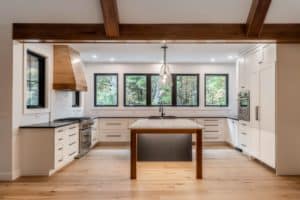
Painting kitchen cabinets can transform a dated kitchen for a fraction of what full replacement costs — $200–$600 in DIY materials versus $15,000–$30,000 for new custom cabinetry. When done right, a painted finish holds for years. When done wrong, it peels within months. This guide walks through every step, the materials that actually matter, and one honest caveat: there are situations where painting is the wrong move, and we will tell you what they are.
What You Will Need: Tools and Materials
- Cleaner: TSP substitute — the most important prep purchase
- Sandpaper: 120-grit for scuffing, 220-grit for between-coat finish sanding
- Primer: shellac-based or high-adhesion oil-based (not standard latex on existing finishes)
- Paint: cabinet-grade water-based alkyd or 100% acrylic formulated for cabinetry (Benjamin Moore Advance, Sherwin-Williams Emerald Urethane, and similar professional lines)
- Applicator: high-density foam roller for flat faces plus angled brush for edges, or an HVLP sprayer for a factory-smooth finish
- Painter’s tape and drop cloths
- Screwdriver and labeled bags for hardware removal
- Tack cloths for dust removal between coats
Budget: $200–$400 for a standard kitchen in materials if you own basic tools. Add $150–$300 if you are renting or buying an HVLP sprayer.
Step 1: Remove Doors, Drawers, and All Hardware
Take down every door and every drawer front. Remove all hinges, knobs, and pulls. As you remove each piece, number it and its corresponding opening with painter’s tape on the inside edge. Photograph the full layout before you start.
Work on doors horizontally on sawhorses or a work table whenever possible. Painting flat surfaces gives you far more control over runs and roller texture than working vertically on a hung door.
Step 2: Clean Thoroughly
Grease, cooking residue, and grime are invisible adhesion killers. Paint applied over a contaminated surface will peel regardless of how good the primer is. This is the step most DIYers rush — and the step that explains most failed cabinet paint jobs.
Wash every surface with a TSP substitute mixed to label directions. Follow with a clean water wipe-down. Allow to dry fully — at least 2 hours in good ventilation. If your kitchen has heavy grease buildup near the stove, clean twice.
Step 3: Sand and Scuff
Sand all surfaces with 120-grit sandpaper. You are scuffing the surface to give primer mechanical adhesion, not stripping it down entirely. Work systematically across door faces and frame boxes. If your cabinets have a factory conversion varnish or glossy polyurethane, liquid deglosser alone will not be enough — sand.
After sanding, wipe every surface with a tack cloth. Dust in the finish is permanent.
Step 4: Prime
Skipping primer is the number one DIY mistake on cabinet paint jobs. Use a shellac-based primer (Zinsser BIN is the most common) or a high-adhesion oil-based primer. Shellac bonds to almost any existing surface and seals wood tannins that can bleed through light topcoat colors. Apply one full coat, dry completely per manufacturer instructions, then sand lightly with 220-grit and wipe with a tack cloth before painting.
Step 5: Paint — Coats, Technique, and Drying Time
Apply two to three thin coats rather than one thick one. Thick coats sag and take far longer to cure.
Brush and roller method: Use the roller for large flat faces and the brush for edges, profiles, and inside corners. Roll in one direction and finish with light brush strokes to eliminate roller texture before it sets.
Sprayer method: An HVLP sprayer delivers the closest thing to a factory finish. It requires thorough masking of surrounding areas but eliminates brush marks entirely.
Sand lightly with 220-grit between each coat, wipe with a tack cloth, then apply the next. The between-coat sanding is what produces a smooth, professional result.
Critical — drying vs. curing: Cabinet paint may be dry to the touch in 2–4 hours but does not fully cure for 21–30 days. Treat cabinets gently for the first month. The manufacturer’s data sheet is the authority on timings for whatever product you buy. Benjamin Moore, for example, describes Advance as a waterborne alkyd built with the extended open time needed to flow and level like a traditional oil paint — follow the recoat and cure guidance printed on your can rather than a generic figure.
How Much Does It Cost to Paint Kitchen Cabinets?
- DIY materials: $200–$600 for a standard kitchen. Higher-end cabinet paints ($70–$90/quart) are meaningfully better and worth the cost on a project you want to last.
- Professional painting: Angi’s 2026 cost data puts the national average around $942, with a typical range of $425–$1,466 and larger professionally painted kitchens reaching about $3,200; for a medium kitchen of 13–20 cabinets it reports $1,500–$2,800 (accessed August 2026). Maine rates sit within that national range. For comparison against new cabinetry, see our 2026 guide to custom kitchen cabinet costs in Maine.
When Painting Is Not the Right Call
- Warped or swollen doors: Painting seals in the problem, not the fix.
- Particle board or MDF swelled from moisture: Once the core has expanded, paint creates a false repair that fails within a year.
- Outdated layout that does not work: Paint changes appearance, not function.
- Cabinets at end of life: Repainting extends the timeline briefly but does not change the trajectory.
In any of these situations, a cabinetry consultation is worth having. Maine Cabinet Company works with Greater Portland homeowners on everything from targeted door replacements to full custom kitchen builds — and we are direct about what actually solves the problem. Schedule a free design consultation at our Falmouth showroom at 417 US Route 1, or call us at (207) 956-7727.
Frequently Asked Questions
How long do painted kitchen cabinets last?
With proper preparation and a quality cabinet-grade paint, a painted finish typically lasts 8–15 years before it needs refreshing.
What is the best paint for kitchen cabinets?
Water-based alkyd paints — Benjamin Moore Advance and Sherwin-Williams Emerald Urethane Trim are the most widely recommended — provide the best balance of durability, leveling, and ease of application.
Can you paint over laminate cabinets?
Yes, but it is the most demanding version of this project. Laminate needs aggressive scuffing and a bonding primer. The prep cannot be shortcut.
How long does the whole project take?
A standard DIY kitchen takes 5–7 days from start to final coat. Professional spray work typically runs 3–5 days. Full cure is 21–30 days regardless of method.
Know When to Paint — and When to Replace
For cabinets in good structural condition, painting is a genuine transformation at a fraction of replacement cost. If your cabinets have problems that paint will not fix, Maine Cabinet Company is at 417 US Route 1 in Falmouth. Book a free consultation or call (207) 956-7727. We will give you a straight answer on whether painting, refacing, or custom replacement is the right move for your kitchen.